 Example
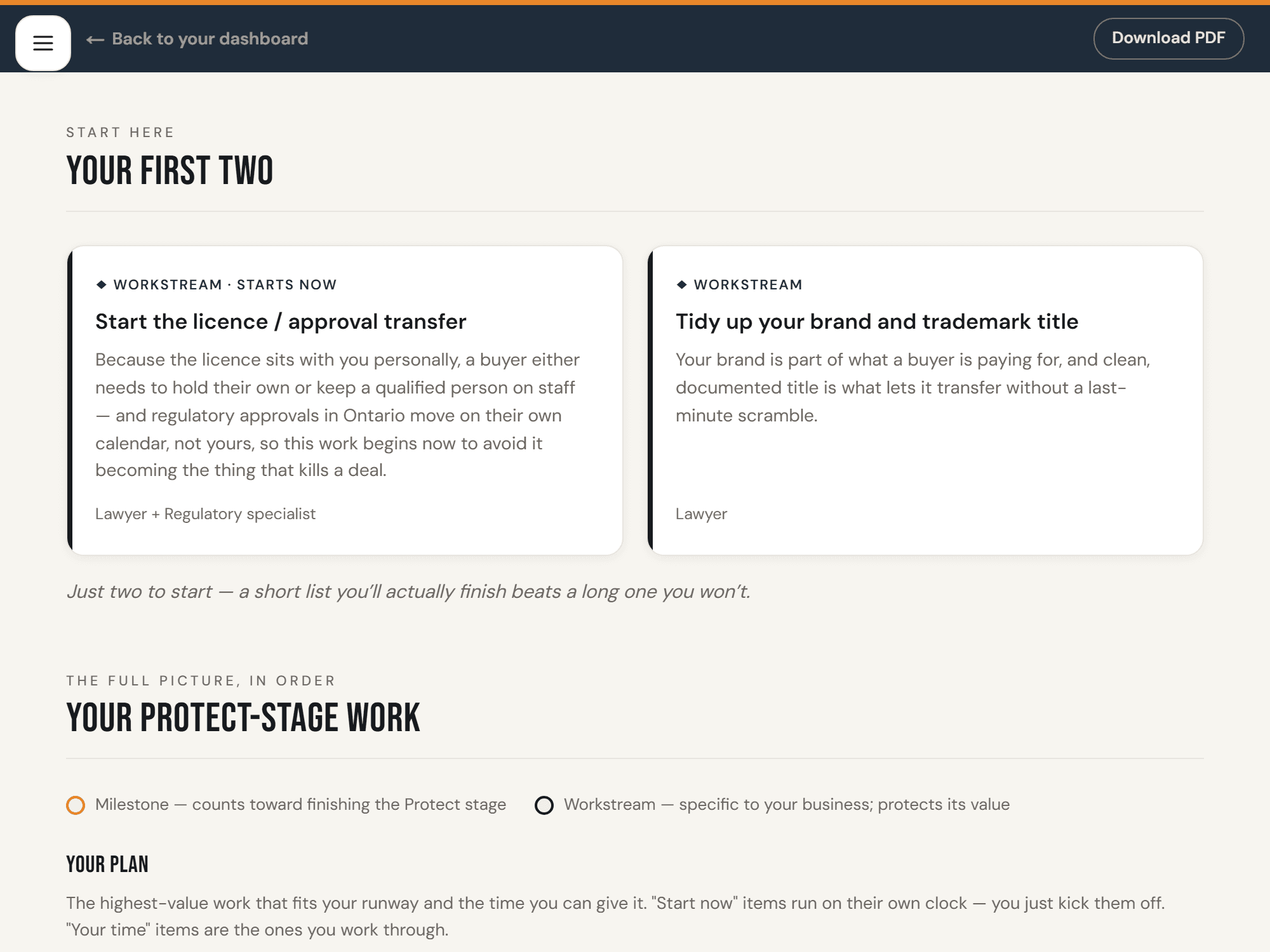
Your plan
Built from your assessment and your sessions: what to tackle, in what order, and why that order. It stays current as you work — finish something and the plan moves on rather than going stale in a drawer.
How it works
No mystery, no “book a demo.” Here’s the whole thing, start to finish.
Seventeen questions, about fifteen minutes, and nothing you need to look up first. What the business does, how many people it takes, who owns it, how it earns. Then the part that actually decides the answer: what would happen if you took a 30-day holiday with no phone or email, how much of the business lives only in your head, whether a stranger could run it from a playbook, and who would take control if you vanished tomorrow. Most are a single tap. The last one is a blank box — what keeps you up at night about all this — and it’s optional.
What comes back is built from your answers, not a template: which of the four stages below your business is actually at and why, one honest observation about what you’ve described — including the parts that aren’t flattering — and what to work on first, each one saying what the platform would do about it and who to call if it belongs to a professional.
It’s free and needs no account. Your readout appears on screen the moment it’s ready; an email is only ever for keeping a copy that outlasts the browser tab.
Successor.pro walks one path:
Make the business safe from surprises — who does what, where things are, what happens if you’re away
Get the jobs out of your head and into guides someone else could follow
Strengthen what makes the business stand on its own
Be genuinely ready to sell it or pass it on
You start at Protect. Your assessment decides what inside it comes first.
You talk — type or speak. The coach asks about your business the way a sharp colleague would: who opens up, what happens when the phone rings, what only you know how to do. Then it turns your answers into the actual documents — and your plan updates to match. You set the pace; sessions fit around a working day, and everything picks up where you left off.
This isn’t one script. Your assessment and your sessions shape the plan around what you actually run — a contracting crew, a clinic, a shop, a one-person consultancy — what you sell, who does what, where you operate, and how far away your exit is. A twelve-person business and a solo business get genuinely different coaching, because the work is different: more hands means more handing off; just-you means building the ways of working that make the business more than its owner. What never changes is the discipline underneath — the established practice of making any business ready to hand over.
ExampleBuilt from your assessment and your sessions: what to tackle, in what order, and why that order. It stays current as you work — finish something and the plan moves on rather than going stale in a drawer.
 Example
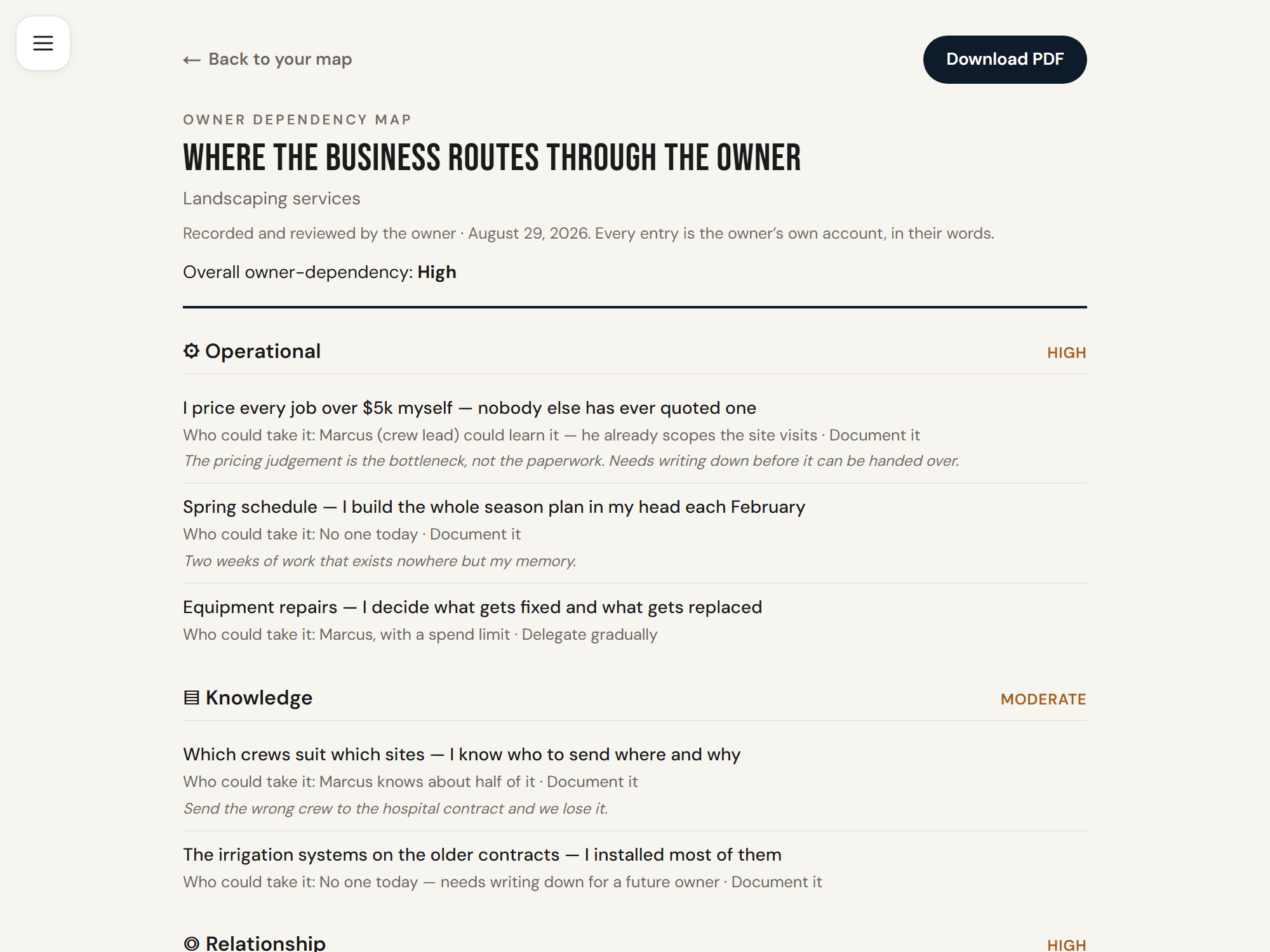
Everything that runs through you, laid out by how much it matters — the operational jobs, the relationships, the knowledge only you hold, and the reputation the business trades on. It is the honest picture of what would break if you weren’t there.
 Example
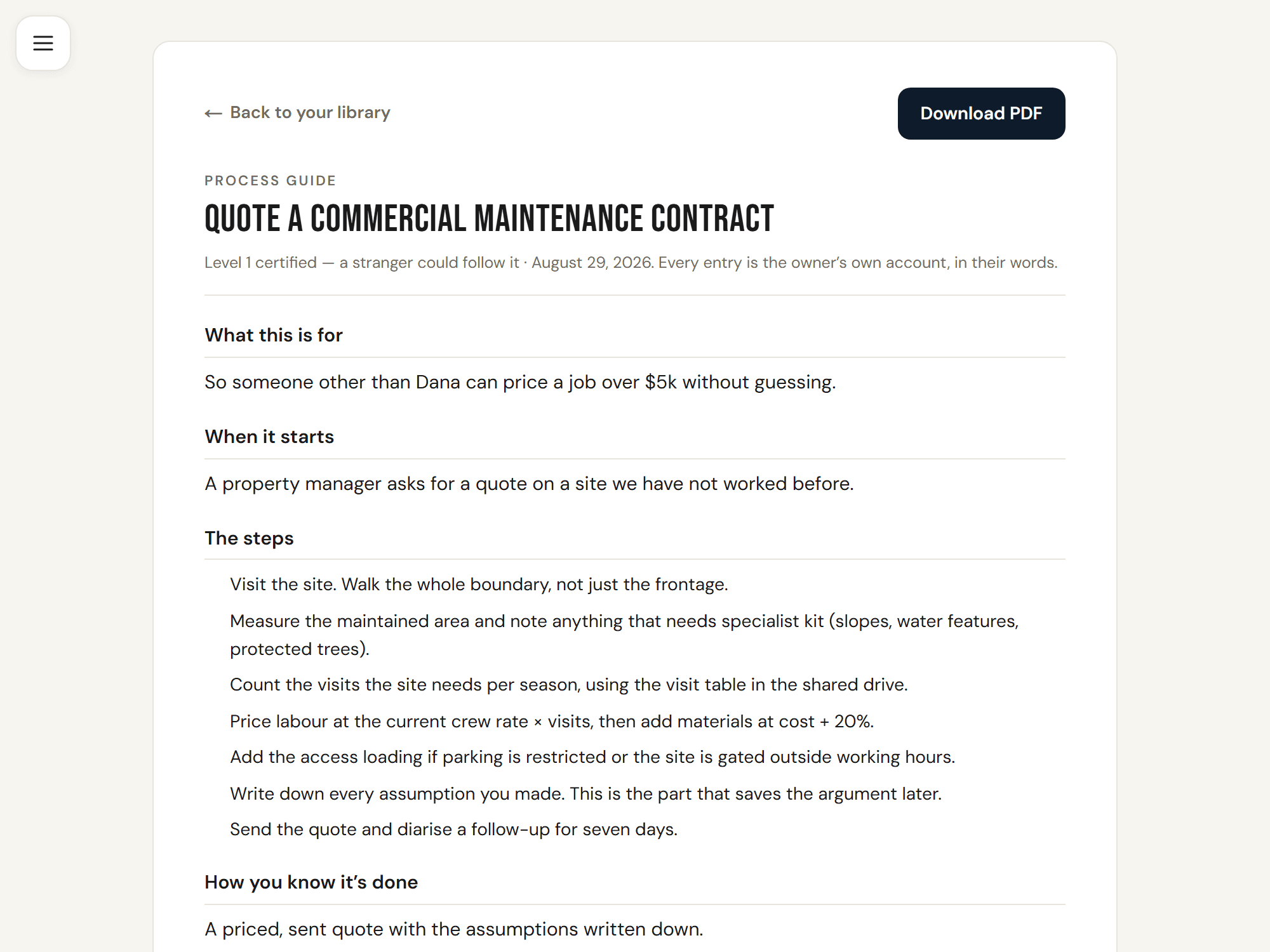
The jobs in your head, written down so someone else could actually do them — the trigger, the steps, what “done” looks like. Written with you in conversation, not typed up by you on a Sunday.
 Example
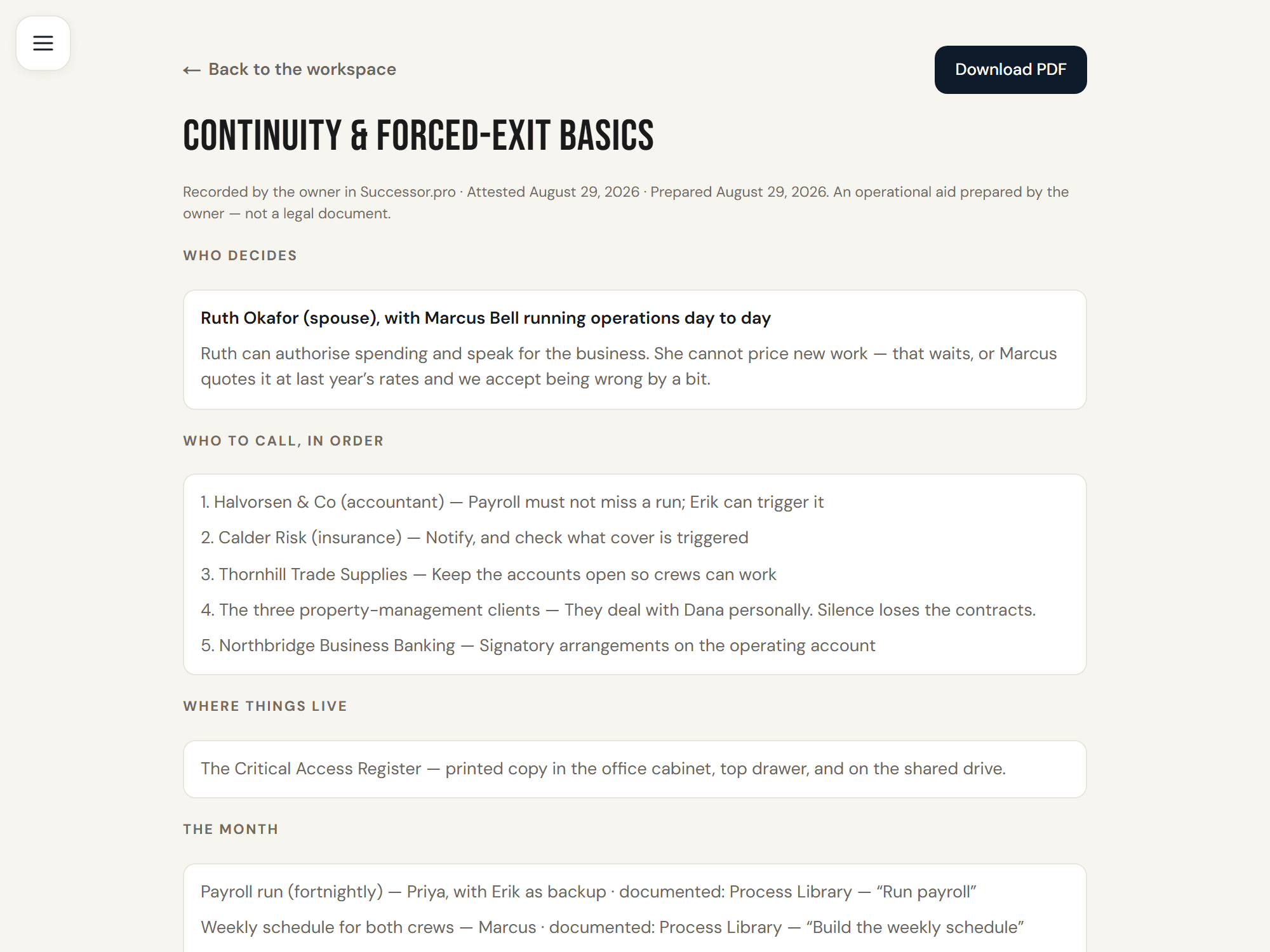
Who does what, where things are, and what happens if you’re away a month: the roles, the critical access records (pointers to where things live — never the passwords themselves), and the basics somebody would need in a hurry.
 Example
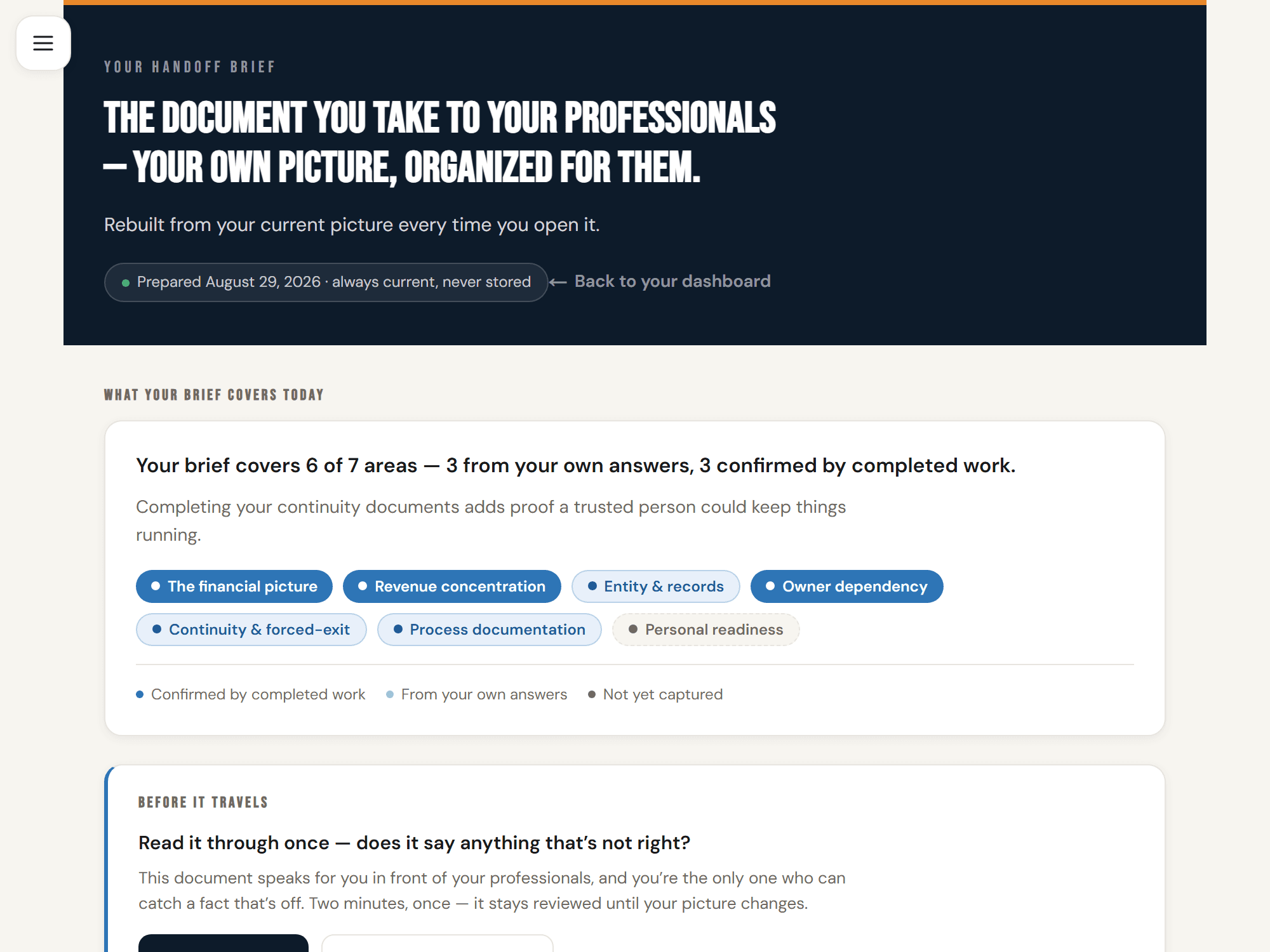
The summary you hand an accountant, planner, or broker — your business, your situation, and what you’ve already documented, in the form a professional can act on. Assembling this picture through professionals typically runs five figures — the published going rates for a valuation plus an exit-plan engagement land at $10–20k before any work begins. The Brief isn’t a substitute for professionals: it’s what makes their time count.
The coach is an AI, and we’re upfront about that — it’s what puts real coaching within reach at all. It knows your business rather than businesses in general: every session builds on the last, so you never start over or re-explain yourself. It works when you do, in as many short sittings as it takes, with no clock running. What it won’t do is step into work that belongs to a professional — it will never value your business, or give financial, legal, or tax advice. That judgment stays with you and the professionals you choose; the coach’s job is the business itself.
It’s your knowledge going into this — nobody else has it, so nobody else can do the work for you. What you get in return: every session moves the plan forward, in sittings short enough to fit a working week, with nothing to write up on your own afterward. Owners who treat it as regular time with the business, not a one-off project, get the most out of it.
About 15 minutes. See where your business stands and what to work on first — instantly, no email needed.